


What is a hybrid bicycle and who is it for? Compare frame types, gearing, and specs, then learn how to choose the right hybrid bike for commuting or fitness.
Introduction
A hybrid bicycle combines the frame geometry and larger wheels of a road bicycle with the upright riding position and wider tires of a mountain or comfort bike. The result is a bike built for mixed conditions — paved streets, light gravel, bike paths — rather than one specific terrain. If you’re deciding whether a hybrid bicycle is right for you, it’s generally the best fit for commuting, fitness riding, and casual recreational use on mostly paved or light-duty surfaces, and a weaker fit for off-road trails, competitive racing, or very long-distance touring.

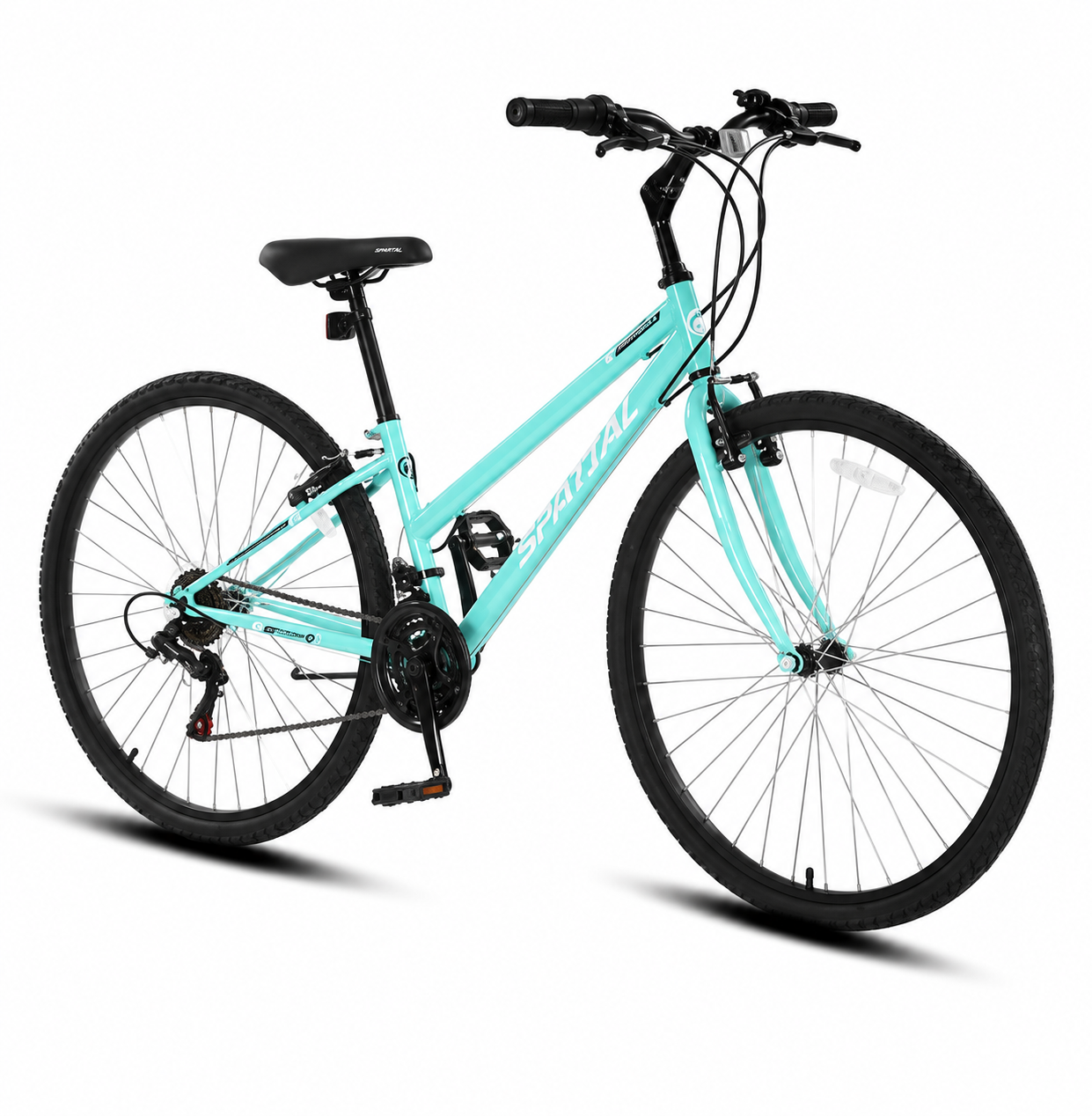
Hybrid bicycle: a commuter-style build with 700c wheels, a 7–21 speed drivetrain, and an upright riding position suited to mixed urban terrain.
What Is a Hybrid Bicycle?
A hybrid bicycle is a bicycle category, not a single fixed design — it exists specifically to blend traits from other bicycle types rather than specialize in one. From the road bicycle, it typically borrows 700c wheels for efficient rolling on pavement. From mountain and comfort bikes, it borrows a more upright handlebar position, a wider tire than a road bike, and often a front suspension fork to soften bumps.
Because “hybrid” describes a design philosophy rather than a strict specification, hybrid bicycles vary more between manufacturers than more narrowly defined categories like road or mountain bikes. Two bikes both marketed as “hybrid” may differ meaningfully in tire width, gearing range, and whether they include suspension — so specifications should always be checked against the specific model, not assumed from the category name alone.
Key Characteristics & Components
The traits that most commonly define a hybrid bicycle include:
- 700c wheels — the same wheel diameter used on road bicycles, generally paired with wider tires for added stability and comfort.
- Flat or slightly raised handlebars — positioning the rider more upright than a road bicycle’s drop bars, improving visibility and comfort for city riding.
- A wide gearing range — commonly 7 to 21 speeds, wide enough to handle moderate hills without the narrower range of a pure road bicycle.
- Disc or V-brakes — disc brakes are increasingly common for more consistent stopping power in wet conditions, though V-brakes remain widespread on lower-cost models.
- Rigid or front-suspension fork — some hybrid bicycles use a rigid fork for lighter weight and efficiency, while others include a front suspension fork (commonly in the 50–63mm travel range on models that include it) to absorb bumps on rougher pavement.
- Aluminum frame — 6061 aluminum alloy is the most common frame material in this category, balancing weight, cost, and durability.
Hybrid Bicycle Specs at a Glance
Key Dimensions & Components
| Spec | Hybrid Bicycle |
| Wheel Size | 700c |
| Brakes | V-Brakes / Disc |
| Weight | 22–28 lbs |
| Frame Material | 6061 Aluminum Alloy |
| Speeds | 7-Speed / 21-Speed |
| Suspension | Rigid / Front Suspension |
| Motor | N/A (Non-Electric) |
| Rider Level | Beginner |
| Specific Use | Urban Commuting & Leisure |
| Price Range | $350–$750 |
These figures represent a typical range across common hybrid bicycle models rather than a single fixed specification — actual weight, gearing, and price vary by manufacturer, component quality, and whether the model includes suspension.
Types of Hybrid Bicycles
Manufacturers don’t use fully standardized subcategory names, but hybrid bicycles are commonly grouped by riding priority:
- Fitness Hybrid — Leans closer to a road bicycle in geometry, with a slightly more forward-leaning position and narrower tires, prioritizing speed and efficiency over maximum comfort.
- Comfort Hybrid — Leans closer to a mountain or cruiser bike, with a more upright position, wider tires, and often front suspension, prioritizing a relaxed ride over speed.
- Step-Through Hybrid — Uses a lowered top tube for easier mounting and dismounting, a design attribute rather than a performance category; it can be paired with either a fitness or comfort setup.
The step-through hybrid bicycle is a common outer variant worth calling out specifically, since it changes accessibility rather than performance:
Key Dimensions & Components
| Spec | Step-Through Hybrid Bicycle |
| Wheel Size | 700c (35–38mm tires) |
| Brakes | Mechanical Disc |
| Weight | 24–30 lbs |
| Frame Material | 6061 Aluminum Alloy |
| Speeds | 7–21 Speed (Shimano) |
| Suspension | Front Suspension (50–63mm) |
| Motor | N/A (Non-Electric) |
| Rider Level | Beginner & Intermediate |
| Specific Use | Urban Commuting & Fitness |
| Price Range | $400–$1,000 |
The step-through frame doesn’t change what the bike is capable of — it changes who can comfortably get on and off it, which matters for riders with limited hip or leg mobility, riders who frequently mount and dismount in traffic, or anyone who prefers not to swing a leg over a top tube.
Hybrid Bicycle vs. Road, Mountain, and Commuter Bicycles
This is where many buyers get stuck, since a hybrid bicycle overlaps in purpose with several other bicycle types.
| Factor | Hybrid Bicycle | Road Bicycle | Mountain Bike | Commuter Bicycle |
| Riding Position | Upright | Aggressive, forward-leaning | Upright, athletic | Upright |
| Tire Width | Medium | Narrow | Wide, knobby | Medium |
| Terrain | Pavement, bike paths, light gravel | Pavement only | Dirt, technical trails | Pavement, daily routes |
| Suspension | Rigid or front | None | Front or full | Rigid |
| Typical Weight | 22–28 lbs | 18–24 lbs | 30–37 lbs | 24–28 lbs |
| Price Range | $350–$750 | $400–$900 | $350–$800 | $400–$800 |
The practical distinction: a hybrid bicycle and a commuter bicycle are close cousins and sometimes overlap almost entirely in real-world use — the difference is often marketing emphasis rather than a hard technical line, with commuter bikes sometimes adding integrated racks, fenders, or lighting mounts as standard. A hybrid bicycle is a better choice than a road bicycle if you value comfort and visibility over aerodynamic speed, and a better choice than a mountain bike if most of your riding stays on pavement rather than trails.
Benefits of a Hybrid Bicycle
- Versatility — handles pavement, bike paths, and light unpaved surfaces without needing a second bike.
- Comfortable riding position — the upright posture reduces strain on the neck, back, and wrists compared to a road bicycle’s drop-bar position.
- Approachable for beginners — wider tires and a stable geometry make a hybrid bicycle more forgiving to learn on than a road bike.
- Practical for everyday errands — many models accept racks, fenders, and baskets more easily than performance-focused road or mountain bikes.
Limitations of a Hybrid Bicycle
- Slower than a dedicated road bicycle — the more upright position and wider tires create more wind resistance and rolling resistance than a road-specific setup.
- Less capable off-road than a mountain bike — hybrid tires and (often) lighter-duty suspension aren’t built for technical trails or sustained rough terrain.
- Component quality varies widely — because “hybrid” isn’t a strict specification, entry-level models can vary significantly in build quality between brands.
- Not built for long-distance touring — while comfortable for daily rides, a hybrid bicycle typically lacks the load-carrying reinforcement of a dedicated touring bike for multi-day trips.
Who Should Choose a Hybrid Bicycle?
A hybrid bicycle is generally the right choice for:
- Commuters riding mostly on pavement, bike lanes, or paved trails.
- Fitness riders who want a more comfortable position than a road bicycle offers.
- Beginners who aren’t sure yet which specialized bicycle type suits them long-term.
- Riders who want one bike that reasonably covers errands, exercise, and casual weekend rides.
A hybrid bicycle is generally not the right choice for competitive road racing (a road bicycle is more efficient), technical off-road trails (a mountain bike is more capable), or dedicated multi-day touring (a touring-specific frame handles cargo weight better).
How to Choose the Right Hybrid Bicycle
- Identify your primary terrain. Mostly smooth pavement favors narrower tires and a rigid fork; mixed pavement and light gravel favors wider tires and front suspension.
- Decide how upright you want to sit. A more upright position improves comfort and visibility; a slightly forward-leaning fitness hybrid improves efficiency.
- Check the gearing range against your local terrain. Flatter areas need less gear range than hilly regions — confirm the low gear is manageable for climbs on your typical routes.
- Consider frame style. A step-through frame improves accessibility and ease of mounting/dismounting without changing the bike’s core capability.
- Match your budget to component quality. Within the $350–$750 range, higher-priced models generally offer better-quality brakes, drivetrain components, and frame finishing rather than a fundamentally different design.
- Confirm compatibility with racks, fenders, or baskets if you plan to use the bike for errands or commuting with cargo.
Naming Differences Across the U.S., Canada, and Europe
The core hybrid bicycle design is recognized across North America and Europe, but terminology isn’t fully consistent. In the U.S. and Canada, “hybrid bicycle” is the standard retail term. In parts of Europe, closely related bikes are often marketed as “trekking bikes” or “city bikes,” which may share similar frame geometry but sometimes come standard with integrated fenders, racks, or lighting — features that are sold separately on many North American hybrid models. When shopping across regions, compare actual specifications (tire width, gearing, included accessories) rather than relying on category naming alone, since the same underlying bike type may be labeled differently by market.
Sizing & Fit
Hybrid bicycles are generally sized using standard frame-height measurements similar to road bicycles, typically expressed in inches or centimeters corresponding to a rider height range. Because sizing charts vary between manufacturers, the most reliable approach is checking the specific brand’s height-to-frame-size chart rather than assuming sizes are standardized across brands. Step-through models offer more flexibility for riders near the edge of two size ranges, since the lower top tube reduces the standover clearance issue that affects fit on a standard frame.
Maintenance Basics
A hybrid bicycle’s maintenance needs sit between a road bike and a mountain bike:
- Tire pressure should be checked regularly; hybrid tires run a wider pressure range than road tires, so consult the sidewall for the manufacturer’s recommended PSI range.
- Drivetrain cleaning matters more on models ridden in wet or gritty urban conditions, since road grime affects the chain and derailleur similarly to how dirt affects a mountain bike’s drivetrain.
- Suspension fork service (on models that include one) should follow the fork manufacturer’s service interval, since neglecting seals and lubrication shortens fork lifespan.
- Brake inspection — whether V-brake or disc, pad wear should be checked periodically, particularly for riders using the bike for frequent stop-and-go city commuting.
Safety Considerations
Riders using a hybrid bicycle for commuting are often sharing roads or mixed-use paths with vehicle traffic, which raises the importance of visibility and basic protective equipment. A properly fitted bicycle helmet and a secure bicycle lock are commonly recommended baseline equipment for daily hybrid bicycle commuting, particularly in urban environments where the bike may be parked in public for extended periods.
Frequently Asked Questions About Hybrid Bicycles
What is a hybrid bicycle used for?
A hybrid bicycle is primarily used for commuting, fitness riding, and casual recreational riding on pavement, bike paths, and light gravel — situations where neither a pure road bicycle nor a mountain bike is the ideal fit.
Is a hybrid bicycle good for long distances?
A hybrid bicycle can handle moderate distances comfortably, but it’s generally less efficient than a road bicycle for sustained long-distance riding due to its more upright position and wider tires, which increase rolling and wind resistance.
What’s the difference between a hybrid bicycle and a commuter bicycle?
The two categories overlap significantly in real-world use; the main distinction is often that commuter bicycles are more likely to come standard with integrated racks, fenders, or lighting mounts, while “hybrid” more often describes the underlying frame geometry and riding position.
Can a hybrid bicycle handle light off-road trails?
A hybrid bicycle can handle light, well-maintained gravel or dirt paths, but its tires and (typically lighter) suspension aren’t built for technical, rocky, or root-heavy mountain bike trails.
How much does a hybrid bicycle cost?
A standard hybrid bicycle typically costs $350–$750, while a step-through hybrid bicycle with features like front suspension and mechanical disc brakes runs $400–$1,000.
Related Guides
- Bicycle Types — Compare the hybrid bicycle against all major bicycle types.
- Road Bicycle — A faster, less upright alternative built purely for pavement.
- Commuter Bicycle — A close cousin to the hybrid, often with racks and fenders built in.
- Step-Through Hybrid Bicycle — The easy-mount variation of the standard hybrid bicycle.
- Basic Bicycle Maintenance — A general maintenance routine to keep your hybrid bicycle running smoothly.
- Bicycle Safety & Security — Helmets and locks recommended for daily hybrid bicycle commuting.